
Choosing the right knee brace
From a light knee sleeve to a hinged ROM brace: the main types of knee brace, what each is designed for, and how to choose the right material, size and fit.
By Novamed · Last updated November 22, 2026
A knee brace can make everyday life and sport feel more secure, but not every brace does the same job. Some simply provide light compression and warmth, others guide the kneecap or add lateral stability, and some restrict movement on purpose. This guide explains the main types, what each one is designed for and what to look out for when choosing.
A knee brace does not replace a diagnosis. If you have an acute injury, swelling, a feeling of instability or persistent pain, please see a doctor first. After surgery, always follow your doctor's instructions.
The types of knee brace
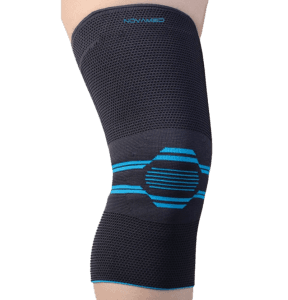
Elastic and knitted knee sleeves
Simple sleeves made of elastic or knitted fabric fit closely around the knee. They are designed to provide light compression and warmth, and many users find they give a pleasant sense of support in everyday life and during sport. Examples: elastic knee support NV.6100 and knitted knee support Classic NV.6323.
Open-patella supports
These supports have an opening at the kneecap (patella), often surrounded by a ring or pad. The ring is designed to guide the kneecap and spread pressure around it, while the kneecap itself stays free. Example: knee support with open patella 6200.
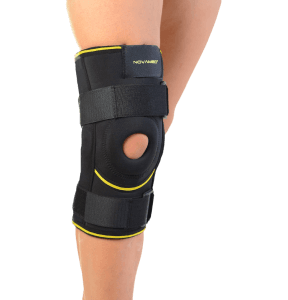
Supports with straps
Adjustable straps let you decide how firmly the support sits around the knee. This way you can fine-tune the stabilisation to your needs, for example for sport or long days on your feet. Example: knee support with straps 6300.
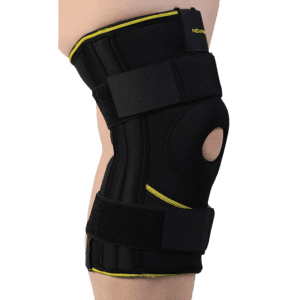
Supports with lateral hinges
Hinges or stays on both sides of the knee are designed to add lateral stability while still allowing the knee to bend and straighten. They come as neoprene supports with hinges or as knitted braces with hinges. Examples: knee support with hinge 6400 and knitted knee brace with hinge NV.6315.
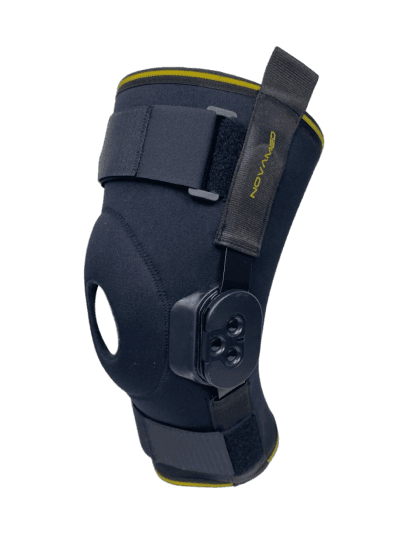
Angle-adjustable hinged knee orthoses (ROM braces)
ROM stands for range of motion. On these orthoses the hinge can be set so that the knee only bends and straightens within a defined range. They are typically used after injuries or surgery on medical advice, and the settings are made by your doctor or orthotist. Examples: knee support with angle-adjustable hinge 6540 and knee ROM brace 6510.
Knee immobilisers
A knee immobiliser keeps the leg straight and the knee still. It is used on medical advice, for example when the knee should not be bent for a while. Example: knee immobiliser 7000.
Patella tendon straps
A narrow strap worn just below the kneecap. It is designed to apply targeted pressure to the patellar tendon and leaves the rest of the knee largely free, which is why many people wear one during sport. Example: patella tendon strap 6210.
Comparison at a glance
| Type | Support level | Typical use |
|---|---|---|
| Elastic / knitted sleeve | light | everyday life, sport, warmth and support |
| Open-patella support | light to medium | guiding the kneecap in everyday life and sport |
| Support with straps | medium, adjustable | individually adjustable stabilisation |
| Support with lateral hinges | medium to high | more lateral stability during movement |
| ROM brace with angle adjustment | high | after injuries or surgery, on medical advice |
| Knee immobiliser | very high (knee kept straight) | on medical advice, when the knee must stay straight |
| Patella tendon strap | targeted, local | sport, pressure on the patellar tendon |
Material: knitted fabric or neoprene?
Knitted fabric is thin, flexible and breathable. It adapts well to the shape of the knee and stays comfortable for longer wear and under trousers.
Neoprene retains more heat and feels firmer. Many people like the warmth, especially in cool weather, but the skin can sweat more underneath. If you have sensitive skin or a known allergy to a material, check the material details on the product page and ask your doctor if in doubt.
Finding the right size
A brace that is too loose slips; one that is too tight constricts. Measure exactly as shown on the product's size chart – it tells you where to measure and how to position your leg. If you fall between two sizes, please contact us before you order. You will find step-by-step instructions in our guide How to measure your size.
How should a knee brace feel?
A well-fitting brace sits firmly and does not slip when you walk. It should not cause numbness, tingling, pinching, lasting pressure marks or discoloration of the skin. Hinges should sit level with the knee joint, and on an open-patella support the kneecap should be centred in the opening. If the brace hurts or you notice any of these signs, take it off and seek advice.
How long should you wear it?
There is no single rule. How many hours a day and for how many weeks depends on why you are wearing it – follow your doctor's advice. This applies in particular to ROM braces and immobilisers. Many people put on a light sleeve only for the duration of their sport. Take regular breaks, check your skin and do not wear a brace at night unless your doctor recommends it.
Care
Follow the care label of each product. In general: close hook-and-loop fasteners before washing, wash gently by hand or in a laundry bag, use a mild detergent, do not wring, and let it air-dry away from radiators and direct sunlight. Remove any removable stays first.
When should you see a doctor first?
- after an acute injury, such as a twist or a fall
- if the knee is swollen, red or warm
- if the knee feels unstable or gives way
- after surgery
- if pain persists or gets worse
- if you have circulation problems, diabetes, loss of sensation, skin infections or open wounds in the area
Your doctor or a specialist retailer can tell you which type suits you and help with the fitting.
Find the right knee brace
You will find all models in our knee braces, knee orthoses and sports knee supports categories. Do you have a question about a product or its size? Contact us.
Frequently asked questions
What is the difference between a knee sleeve and a knee orthosis?
A knee sleeve is made mainly of elastic or knitted fabric and provides light compression and warmth. A knee orthosis has rigid parts such as hinges or splints; it is designed for more stability or to limit movement and is often worn on medical advice.
Can I wear a knee brace during sport?
Many people wear a light sleeve, an open-patella support or a patella tendon strap during sport. Make sure it fits well without constricting. After an injury, ask your doctor before you return to sport.
Which size should I choose if I am between two sizes?
Measure again exactly as described on the product's size chart. If you are still between two sizes, contact us before you order and we will help you choose.
Can I wear a knee brace all day?
That depends on why you are wearing it. Follow your doctor's advice, take breaks and check your skin regularly. Take the brace off if it pinches, hurts or causes tingling.
Who adjusts a ROM brace?
The range of motion is set by your doctor and adjusted by the doctor or an orthotist. Only change the settings after talking to them.
Products from this guide



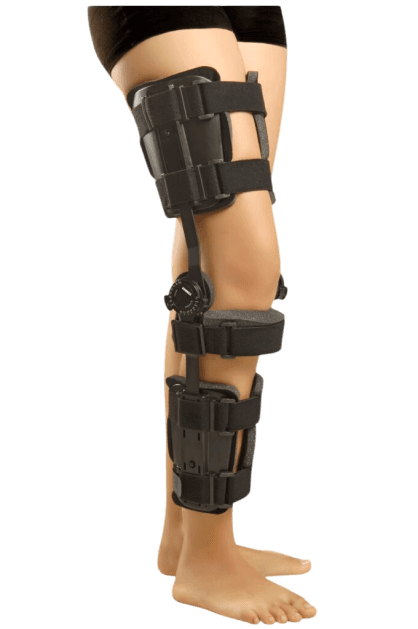
Knee Rom Brace
£177.55In stock